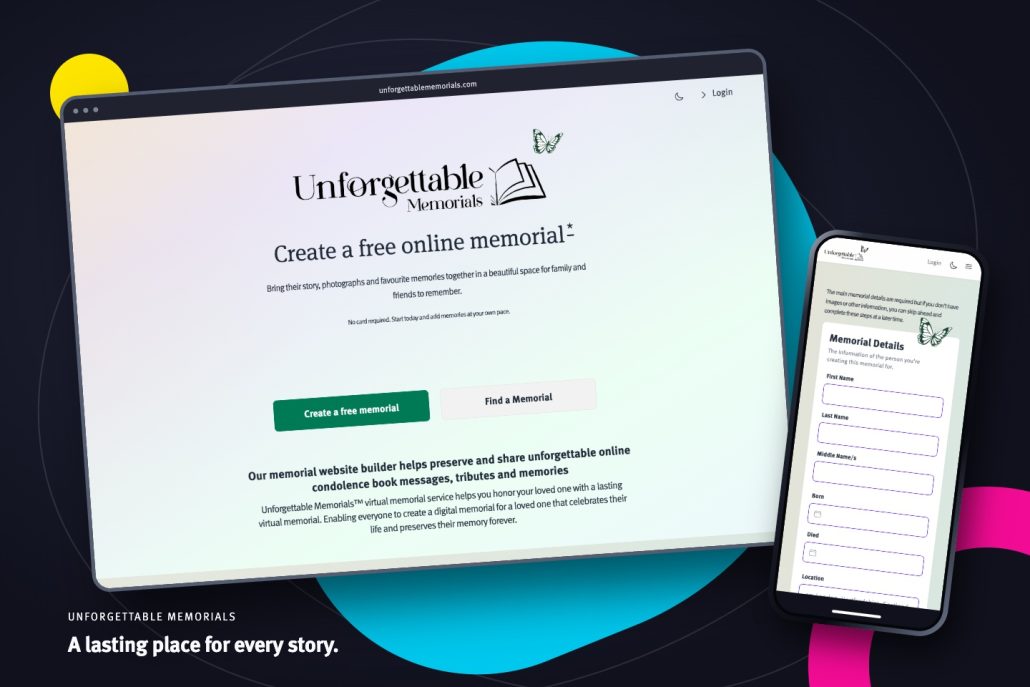
A brand built around people and their memories
A memorial service needs to do more than present a list of features. It needs to feel approachable at a moment when people may not have every photograph, date or word ready. The brand and customer journey were shaped around making a meaningful start, with space to return and add more.
Working with the client, we brought the visual identity, product proposition and memorial experience into the same conversation. The aim was a recognisable service that helps people understand what they can create, how others can contribute and how the memorial can grow.
Define a useful MVP, with room for the wider ambition
The client’s ambition extended beyond a standalone tribute page. We helped shape an MVP architecture around the central job: creating and sharing a memorial that can bring a community’s memories together.
That meant giving the first experience a clear scope while considering the services that might follow. Memorial content, contribution workflows, partner relationships and external transactions need clear responsibilities, so future integrations can extend the product without forcing a new foundation.
Client feedback helps keep those architectural choices connected to the experience people actually need. The delivery approach supports useful increments, reviewed in context, rather than treating the MVP as a disposable first version.
From client ambition to useful MVP
The client-led MVP approach connects the brand and customer journey to useful first-release scope, feedback and phased extensions.

High-level workflow. Explore horizontally on smaller screens.
An engaging builder, a shared place to remember
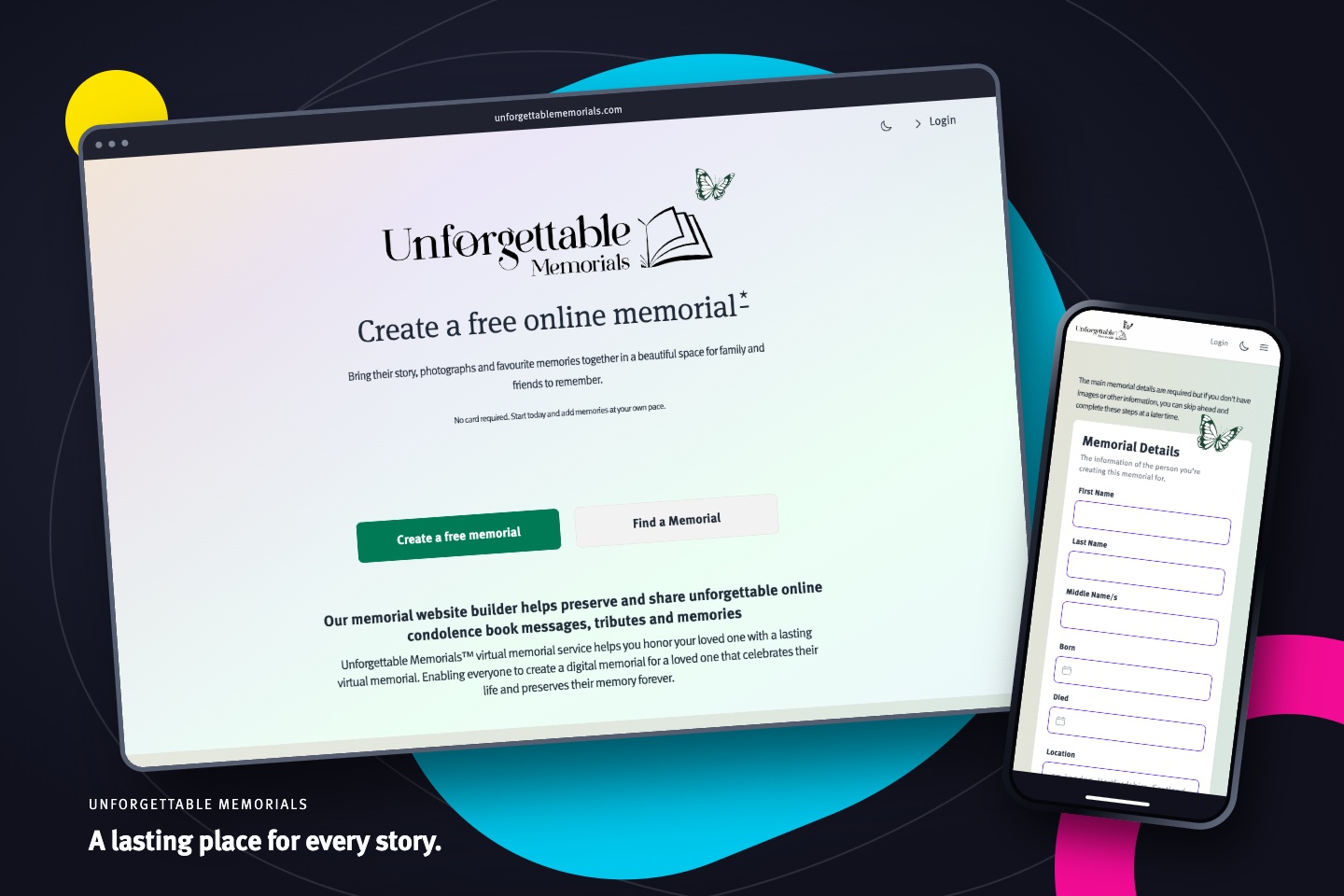
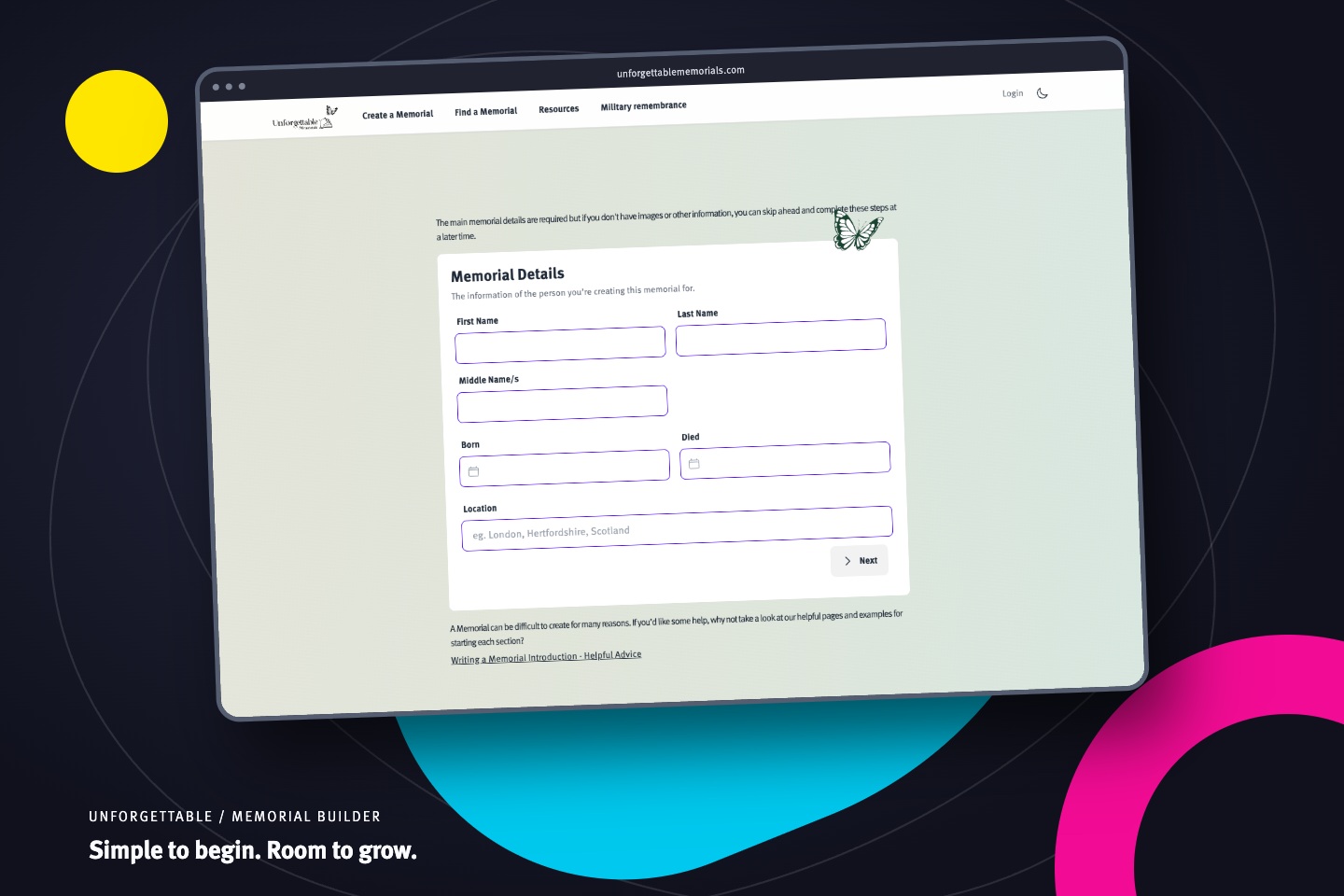
The memorial builder guides people through the detail in stages, with photographs, personal stories and other content becoming part of a lasting page. A family can begin with the essentials and develop the memorial as more memories become available.
Community is part of the experience: family, friends and colleagues can be invited to contribute. Sharing choices and custodian review give the memorial’s owner a role in how that space develops.
The screenshots show the public entry experience and the empty builder. No personal information was entered and no memorial was created for the portfolio.
Composable APIs, with the memorial at the centre
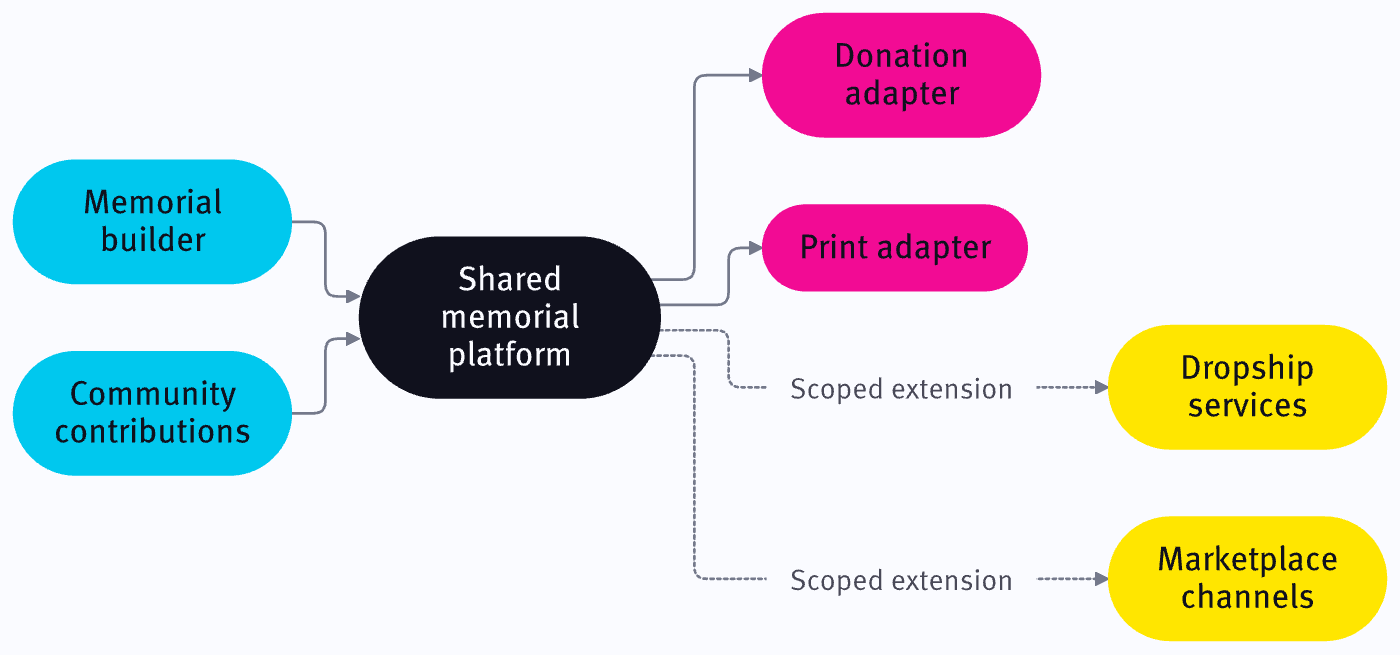
The memorial is the shared point of reference. Customer experiences, partner services and integrations connect to it through defined responsibilities, rather than each creating a separate copy of the story.
API scope and adapters separate the core product from the formats and rules of individual providers. This creates a practical basis for adding services in stages: agree the data exchange, define the outcome and check the handover before expanding the connection.
The architecture view is deliberately high-level. It explains the product responsibilities without publishing private endpoints, customer records or proprietary implementation details.
One memorial, connected possibilities
Shared memorial responsibilities with donation and print adapters. Dropship and marketplace connections are scoped extensions; provider rollout is phased.
High-level workflow. Explore horizontally on smaller screens.
Giving and printed remembrance, with distinct handovers
Donation integration work gives fundraising its own provider boundary, beneficiary context and confirmation-led records. A donation request and its confirmed outcome are different parts of the journey; the memorial experience can remain coherent while those transactions are handled by the appropriate service.
Print-on-demand integration work connects memorial content to a physical remembrance workflow. Content selection, proof revisions and a fulfilment adapter provide a route from the digital memorial to a printed item, with order status kept alongside the request.
The core memorial experience is live. Donation and print-on-demand integrations are part of ongoing platform development, with activation and operational rollout managed in phases. The diagram describes those designed handovers rather than claiming every provider route is already live.
Optional services, deliberate handovers
Designed handovers for giving and print fulfilment. Requests, provider confirmations and recorded outcomes remain distinct. Activation depends on the agreed integration route.

High-level workflow. Explore horizontally on smaller screens.
Dropship and marketplace compatibility as an extensible scope
The same composable approach leaves room for dropship services: supplier-direct fulfilment can connect through agreed product, order and status exchanges, while the memorial builder keeps its own focus.
Marketplace compatibility is also part of the API scope. Catalogue information, customer choices and order events can be mapped to the requirements of an agreed channel instead of embedding a marketplace’s assumptions throughout the core platform.
These are scoped extensions. Each supplier or marketplace connection needs its own capability, data and fulfilment checks; compatibility is defined for the chosen route rather than assumed for every channel.
- Donation integration: provider-aware transactions and confirmed outcomes.
- Print-on-demand integration: content, proof and fulfilment handovers.
- Dropship scope: supplier-direct order and delivery exchanges.
- Marketplace scope: channel-specific catalogue and order compatibility.
A foundation for a product that keeps growing
The result is a brand and a live memorial experience supported by an architecture that can accommodate a broader service. The MVP gives the client a useful foundation while keeping the next decisions visible.
Community features, giving, printed remembrance and partner channels can be developed around the same memorial. The value is continuity: a coherent place for the family, with well-defined connections behind the scenes.